Showing posts with label History. Show all posts

Monday, July 26, 2010

Historic Gates of Taipei

Part of my Taipei resource

Taipei, the bustling city of today, used to have a wall with 5 gates something over a century ago. What remains today are 4 gates, of which only 1 survived in its original form. All gates were constructed between 1879 and 1884 during the rule of the Qing Dynasty. One gate (namely the West Gate) and the wall were destroyed and removed by the Japanese during their occupation of Taiwan (1895-1945) and was never reconstructed. The CKS government of the Republic of China (Taiwan) modified 3 of the 4 remaining gates in 1966 by changing the upper part of the original gates into a northern Chinese style architecture (supposedly "to make Taipei more attractive to tourists", that worked out well, didn't it?) and that's why there's only one gate in its original form today (namely the North Gate).

1 List of the historic gates of Taipei

Please click on the photos to read an article about a particular gate.

Beimen.

Nanmen.

Xiaonanmen.

Dongmen.

Ximen.

2 Location map of the historic gates of Taipei

Qing dynasty gates in Taipei
Here you can see where the gates stand today. The West Gate doesn't exist anymore.

3 Timeline of rulers over Taiwan (links to Wikipedia)

Before WWII: [Qing Dynasty 1683-1895][Japanese occupation 1895-1945]
After WWII: [Kuomintang 1945-2000][DPP 2000-2008][Kuomintang 2008-]

4 Related posts and more info (in traditional Chinese)

[Gates of Taipei Wikipedia][Gates overview: 城門的建築型式][Blog post with maps]
[Blog post about history of Taipei's walls and gates][NCYU article about the gates]


[My TAIPEI page][My TAIWAN page][All marked photos by MKL, 2010]

Sunday, July 18, 2010

National Revolutionary Martyrs' Shrine, Taipei

In honor and memory of the war dead of the Republic of China

The main gate.

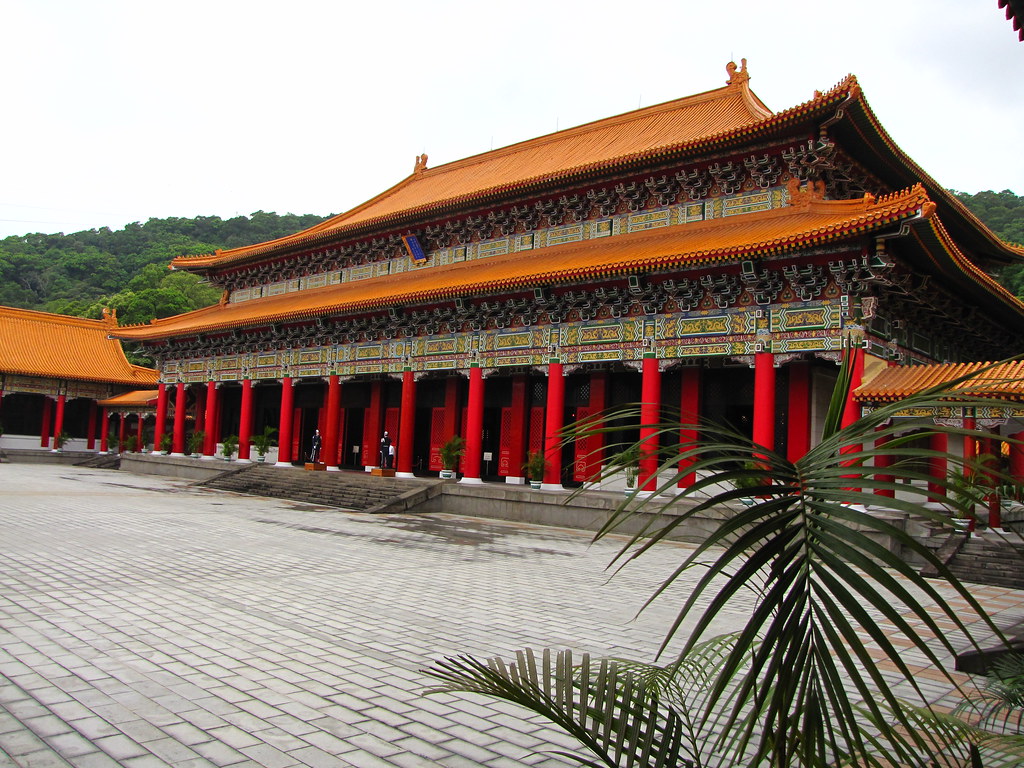
National Revolutionary Martyrs' Shrine in Taipei (Chinese 國民革命忠烈祠) is a special place dedicated to the soldiers of Republic of China (official name of Taiwan today, but the state was founded in 1911), who died for their country in past wars, such as in the Chinese Civil war and few others (more info here). It's a solemn place, but it's also open to visitors, so if you're visiting Taipei, it's definitely one of the places you should see. If you're interested in the history of Republic of China, you should visit the Martyrs' Shrine along with the Chiang Kai-shek Memorial Hall and Sun Yat-sen Memorial Hall. All there places are admission free.

A huge gate at the entrance of the Martyrs' Shrine with a guarding soldier.

The main gate from up close.

The main gate from the inside.


The National Revolutionary Martyrs' Shrine was built in 1969. The photos here were made by my girlfriend, who visited the the shrine today, but she did not take photos of the main building. You can see a photo here (by H&XL). That building is supposed to resemble the Hall of Supreme Harmony in Beijing. But my girlfriend said it's being renovated currently, keep that in mind, if you plan to make photos of the shrine these days.

On the left photo you can see a soldier guarding the main gate. They have to stand still for 1h hour. No movements are allowed. They only have someone, who wipes of the sweat from their faces. Every full hour there is a changing of the guards ceremony and it's really worth to see. If you haven't seen that yet, check the embedded video below.

The soldiers, who get the honor of being guards at the Martyr's Shrine need to meet some qualifications: No criminal history, at least a high school education, be between 175cm - 195cm tall, weigh 65kg (± 1kg) and need to have a lot of discipline (source). As you may imagine, only the best of the best are eligible to guard one of the most important places of remembrance in the Republic of China.

The changing of the guards ceremony.

Rwo kinds of uniforms, blue soldiers are from the Air Force, white from the Navy.

Changing of the guards (Seen a woman with a baby passing by?)

The shrine is located near another famous building: The Grand Hotel.

I had to post these photos here, because they're really good. Thanks again to my girl, who took the time to visit the place and made these great shots. Taipei is so hot this summer, you can see that in the last photo, but that makes the photos pretty good. Let's take a second and think about those soldiers, who have to stand under the scorching sun of Taipei for a full hour without moving. I admit, I would not be able to do this. I'm not soldier material. How about you?

[Military of the Republic of China][All photos by LilyChen, 2010]

Tuesday, May 4, 2010

History of fashion..

Fashion, a general term for the style and custom prevalent at a given time, in its most common usage refers to costume or clothing style.


The more technical term, costume, has become so linked in the public eye with the term "fashion" that the more general term "costume" has in popular use mostly been relegated to special senses like fancy dress or masquerade wear, while the term "fashion" means clothing generally, and the study of it. This linguistic switch is due to the fashion plates which were produced during the Industrial Revolution, showing the latest designs.[citation needed] For a broad cross-cultural look at clothing and its place in society, refer to the entries for clothing, costume and fabrics. The remainder of this article deals with clothing fashions in the Western world

The continually changing fashions of the West have been generally unparalleled either in antiquity or in the other great civilizations of the world until recent decades. Early Western travellers, whether to Persia, Turkey, Japan or China frequently remark on the absence of changes in fashion there, and observers from these other cultures comment on the unseemly pace of Western fashion, which many felt suggested an instability and lack of order in Western culture. The Japanese Shogun's secretary boasted (not completely accurately) to a Spanish visitor in 1609 that Japanese clothing had not changed in over a thousand years. However in Ming China, for example, there is considerable evidence for rapidly changing fashions in Chinese clothing.

Changes in costume often took place at times of economic or social change (such as in ancient Rome and the medieval Caliphate), but then a long period without large changes followed. This occurred in Moorish Spain from the 8th century, when the famous musician Ziryab introduced sophisticated clothing styles based on seasonal and daily timings from his native Baghdad and his own inspiration to Córdoba, Spain. changes in fashion occurred in the Middle East from the 11th century, following the arrival of the Turks who introduced clothing styles from Central Asia and the Far East.

The beginnings of the habit in Europe of continual and increasingly rapid change in styles can be fairly reliably dated to the middle of the 14th century, to which historians including James Laver and Fernand Braudel date the start of Western fashion in clothing. The most dramatic manifestation was a sudden drastic shortening and tightening of the male over-garment, from calf-length to barely covering the buttocks, sometimes accompanied with stuffing on the chest to look bigger. This created the distinctive Western male outline of a tailored top worn over leggings or trousers.

The pace of change accelerated considerably in the following century, and women and men's fashion, especially in the dressing and adorning of the hair, became equally complex and changing. Art historians are therefore able to use fashion in dating images with increasing confidence and precision, often within five years in the case of 15th century images. Initially changes in fashion led to a fragmentation of what had previously been very similar styles of dressing across the upper classes of Europe, and the development of distinctive national styles, which remained very different until a counter-movement in the 17th to 18th centuries imposed similar styles once again, finally those from Ancien Régime in France. Though the rich usually led fashion, the increasing affluence of early modern
Europe led to the
bourgeoisie and even peasants following trends at a distance sometimes uncomfortably close for the elites - a factor Braudel regards as one of the main motors of chang
ing fashion.


Marie Antoinette was a fashion icon..


Ten 16th century portraits of German or Italian gentlemen may show ten entirely different hats, and at this period national differences were at their most pronounced, as Albrecht Dürer recorded in his actual or composite contrast of Nuremberg and Venetian fashions at the close of the 15th century (illustration, right). The "Spanish style" of the end of the century began the move back to synchronicity among upper-class Europeans, and after a struggle in the mid 17th century, French styles decisively took over leadership, a process completed in the 18th century.

Though colors and patterns of textiles changed from year to year, the cut of a gentleman's coat and the length of his waistcoat, or the pattern to which a lady's dress was cut changed more slowly. Men's fashions largely derived from military models, and changes in a European male silhouette are galvanized in theatres of European war, where gentleman officers had Albrecht Dürer's drawin contrasts a well turneoutbourgeoisefromNuremberg (left) with counterpart from Venice. The Venetian lady's high chopines make her taller (About photo)

opportunities to make notes of foreign styles: an example is the "Steinkirk" cravat or necktie.

The pace of change picked up in the 1780s with the increased publication of French engravings that showed the latest Paris styles; though there had been distribution of dressed dolls from France as patterns since the 16th century, and Abraham Bosse had produced engravings of fashion from the 1620s. By 1800, all Western Europeans were dressing alike (or thought they were): local variation became first a sign of provincial culture, and then a badge of the conservative peasant.

Although tailors and dressmakers were no doubt responsible for many innovations before, and the textile industry certainly led many trends, the history of fashion design is normally taken to date from 1858, when the English-born Charles Frederick Worth opened the first true haute couture house in Paris. Since then the professional designer has become a progressively more dominant figure, despite the origins of many fashions in street fashion. The four major current fashion capitals are acknowleged to be Milan, New York City, Paris, and London. Fashion weeks are held in these cities, where designers exhibit their new clothing collections to audiences, and which are all headquarters to the greatest fashion companies and are renowned for their major influence on global fashion.

Modern Westerners have a wide choice available in the selection of their clothes. What a person chooses to wear can reflect that person's personality or likes. When people who have cultural status start to wear new or different clothes a fashion trend may start. People who like or respect them may start to wear clothes of a similar style.

Fashions may vary considerably within a society according to age, social class, generation, occupation, and geography as well as over time. If, for example, an older person dresses according to the fashion of young people, he or she may look ridiculous in the eyes of both young and older people. The terms fashionista or fashion victim refer to someone who slavishly follows the current fashions.

One can regard the system of sporting various fashions as a fashion language incorporating various fashion statements using a grammar of fashion. (Compare some of the work of Roland Barthes.)


Los Angeles Fashion Week 10/13/2008

Monday, April 26, 2010

Sejongno, Seoul

A famous street in the heart of Seoul


Sejongno (also Sejong-ro or 세종로/世宗路) is one of the famous streets (although it looks like a square) in the historic center of Seoul. Although the part you see on the photos is new, but the location is very close to other famous spots in Seoul, some of which are: Gwanghwamun in the north (currently being restored) with the Gyeongbok palace (and the Korean National folk museum). There's also the American embassy nearby, which is heavily protected. Many government buildings are located here as well, so you can see a lot of police and military presence near and at Sejongno.

The street is named after the Korean King Sejong. A famous king, who invented the Korean alphabet hangul in the 15th century (this one -> 대한민국을 사랑합니다/사랑해요). So there's a big statue dedicated to king Sejong's honor. But there's another statue dedicated to a famous Korean admiral named Yi Sun-sin. He was a victorious naval commander of Korean forces against Japanese during the Japanese invasions of Korea between 1592-1598. It's said, that he never lost a battle and he participated in 23. No wonder he got such a prominent place in Seoul. Japan was historically the no 1 enemy of Korea. See my photos.

The majestic Yi Sun-sin above Sejogno.

He defended Korea against Japanese invaders in the late 16th century.

King Sejong the great, invented the Korean alphabet.

Is he the father of modern Korea? Most likely, I would say.

No comments here, thanks.

[My Korea][Photos by MKL, 2010][Wiki: Sejongno, King Sejong, Admiral Yi Sun-sin]

The Five Grand Palaces of Seoul

The magnificent palaces built during the Joseon dynasty

Let me introduce you the Five Grand Palaces of Seoul, one of the main sights of this amazing city. I only saw three of the five, but those were the biggest and the main ones, which are well preserved and being further restored. They're located in the northern part of the historic Seoul and most of the tourists go and see these palaces. So in case you're heading there one day, here's a brief intro. In my upcoming posts I will post some beautiful photos of the three palaces I've seen, I hope you will like it. So here they are, placed in order by their significance:

Chang·deok·gung [창덕궁/昌德宮] - "Palace of Prospering Virtue"

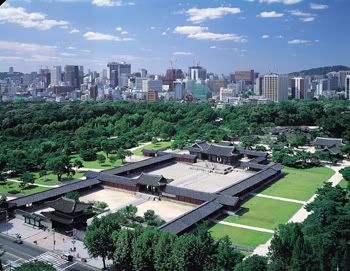
Changdeokgung Small

This incredible Korean royal palace is today a UNESCO World Heritage Site. It's like a holy place for Koreans. This is my favorite palace of the three I've seen. It's huge and massive, with a beautiful secret garden and amazing architecture [source].

Gyeong·bok·gung [경복궁/景福宮] - "Palace Greatly Blessed by Heaven"

Gyongbokgung Small

This was the main palace of the Korean kings during the Joseon dynasty. It's truly an amazing place. You can see the changing of the guards ceremony in front of the main gate. The National Folk Museum of Korea is also located near by and during my visit, there was some beautiful sakura everywhere [source].

Chang·gyeong·gung [창경궁/昌慶宮] - "Palace of Flourishing Gladness"

Changgyeonggung

This former palace of Korean kings is also very interesting. It's the first one I have visited. The whole area is big, if you include gardens and Jongmyo, so you'll have a lot of walking to do, if you want to see everything. But the palace itself is not so big and there's not so many accompanying buildings like with the previous two palaces. It's worth to see the whole premise [source].

Deok·su·gung [덕수궁/德壽宮] - "Palace of Virtuous Longevity"

Like every of the palaces, this one was also heavily destroyed by the Japanese and only 33% of the original size remains. I haven't visited this palace during my trip [more here].

Gyeong·hui·gung [경희궁/慶熙宮] - "Palace of Serene Harmony"

This palace was completely destroyed by the Japanese and has been rebuilt in the recent years. I haven't visited this one as well [more here].

No comments here, thanks.

Changgyeonggung, Seoul

Palace of Flourishing Gladness in 2010

Main throne hall of Changgyeonggung.

Let me introduce you the last grand palace of the three I've seen in Seoul. The name is Chang·gyeong·gung [창경궁/昌慶宮] or the "Palace of Flourishing Gladness" and it's also a very interesting Korean royal palace. It's the first one I have visited. The whole area is big, if you include gardens and Jongmyo (where you need to enter and buy the ticket, cost me 1000 Won). You'll have a lot of walking to do, if you want to see everything. But the palace itself is not so big and there's not so many accompanying buildings like with the previous two palaces. It's worth to see the whole premise, though. I think it's best to see Changgyeonggung as the first of all the palaces (it's located in the east part) and then go to the western part and see the other four of the Five Great Palaces of Seoul. Enjoy my photos of this lovely place:


Jongmyo, a Confucian shrine, is where you enter, if you're going to see Changgyeonggung. It's a UNESCO World Heritage Site and definitely worth to see.

See my photos of amazing Jongmyo here>>

The gate from Jongmyo to Changgyeonggung. Both parts are surrounded by a wall.

The Changgyeonggung palace complex.

The cherry blossoms were beautiful that day.

Haminjeong (涵仁亭) or the royal pavilion.

Hwangyeongjeon hall (歡慶殿) royal residence. The king slept here.

Off to the main part of the palace.

Myeongjeongjeon, the main throne hall

The buildings are very close to each other.

On the right side is the throne hall, in front is the courtyard.

The gate is named Myeongjeongmun (明政門).

Myeongjeongjeon (明政殿), the main throne hall of Changgyeonggung.

The throne of Korean kings.

The so called Bonghwang phoenixes above the throne.

The only photo of the front of Myeongjeongjeon was taken by a Korean man, who I ask for help. I don't know, why I didn't take photos of the whole building from the front. Bummer "-_-

The throne hall from the side.

Munjeongjeon hall, the council hall

Munjeongjeon hall (文政殿). The king dealt with state affairs here.

Inside Munjeongjeon hall. Very colorful and very well restored.

King's main spot.


After that I went uphill, above the palace is a forest, that leads to a pond.

This pond is called Chudangji and there's a lovely small island in the middle.

A greenhouse at the end. It has a beautiful garden.

View on the Namsan mountain and Namsan tower, my next destination.

How did you like my photos?

[My Korea][All photos by MKL except the small, 2010][Changgyeonggung Map]